Nybrogrus AB
Objective
The conservation objective is to protect a flowering landscape with an exceptional insect population.
Context
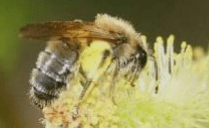
This sand and gravel extraction site has been operating and growing gradually since late 1972 and is today occupying 20 hectares. Part of the extraction site is restored and is planted with pine forest. Although the extraction site still is active, large parts are now objects of restoration. Within the extraction site there are several structures that enforce high biodiversity such as steep sandy slopes, sand and soil piles, warm sandy soils with flowering herbs and flowering forest edges. The red-listed bank swallow Riparia riparia has large colonies in south-faced high sand banks in the northern part. In this sand extraction site 8 red-listed insect species have been detected during a recent survey financed by the County Administration. Among these is the very rare cuckoo bee Nomada similis and its host Panurgus banksianus (see photo). Until this finding in 2007, this cuckoo bee’s only known north Europe location was presumed to be the island of Öland.
Solution
Every company that exploits natural resources in Sweden is obliged to present a restoration plan for each quarry. Traditionally, these restoration plans focus on geological and hydrological questions and do not take biodiversity into account. In this particular case, the restoration plan will be influenced by the high biodiversity and the needs of particular threatened species.
Result
As a result of the inventory and the discussions with the company Nybrogrus AB, an ecological restoration will begin. As far as possible, this restoration will save, restore and manage the habitat of the threatened species that live in this sand extraction site. The project is finished and returned to the land owner. Nowadays, the developments and present status of the area is now controlled by Länsstyrelsen, which has the responsibility to overwatch environment and nature preservation and also make natural value inventories in the region.
Partners
In this project the local entomological society www.fsoe.se and the nature conservation unit at the County Administration Board in Kalmar are partners.