Carmeuse
Objective
Conversion of a quarry into a natural zone, while maintaining and increasing biodiversity.
Context
Carmeuse has operated the Moha site since the early years of the 20th century. The rule has always been that sites are rehabilitated as extraction progresses.
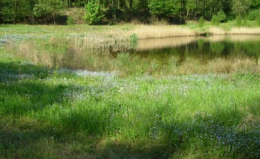
After exploitation (in 1972), the site of the Vallêche pond beside the Mehaigne was used as a slag pond: the sides of the pond were raised as it was filled with the deposits of clay. The banks were replanted at the same time.
Solution
At the end of its use as a slag pond in the late 1980s, a wetland area was maintained on part of the site, the remainder being replanted with trees of different species. Over time, human intervention was required to enable the site to maintain its current character. Apart from the traditional maintenance of a wooded area, these works included:
Fighting the lowering water level, which entailed sealing the banks;
Preventing an anarchic growth in carp numbers;
Controlling the reed bed which tended to invade the entire pond.
Result
Today the site is home to interesting wild life: eagle owls, grey herons, song thrushes, little grebes, slow worms, green and common frogs, etc.
This experience shows the scope of rehabilitation to create significant biodiversity.
However, this is not possible without human intervention and monitoring, and sometimes requires the adaptation of planting to suit the area (in particular the choice of species). In the region, this type of pond is a valuable substitute for the sugar refinery ponds which have now disappeared, and is often used by resting migratory birds.