Rudus Oy
Context
The 1982 Land Extraction Act protects groundwater areas from excavation. Soon after, the Finnish Environmental Agency, together with the Finnish urban planning authority, began a project to return old gravel pits to their natural state.
A study by the Ministry of the Environment concluded depth played a significant role in groundwater eutrophication. This could be prevented providing pits were deep enough to prevent sunlight reaching the bottom.
Once owned by Finnish State Railways, VR, the old gravel area in Mellilä, had been disused since the 1960s. The excavation was so deep that groundwater had leaked to form puddles on the surface.
The project
The local environmental authority decided to take action to protect the groundwater, but lacked the funds to restore or fill-in the pits. At the time, Rudus had rights to an adjacent piece of land where gravel extraction had not begun. Mellilä municipality and Rudus reached a negotiated settlement that saw Mellilä take ownership of the land in return for Rudus being granted a soil extraction permit to a wider area.
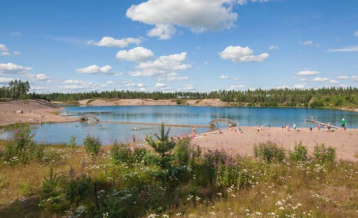
After careful studies of the groundwater, approval was granted for the construction of a lake, which Rudus began shaping by extracting sand. Lake Mellilänjärvi is the only gravel pit in the region to be restored using excavation. Rudus cleared the pit of scrap and dug out enough sand to create a 600-by 150 metres wide lake with an average depth of around 10 metres.
Result
Rudus used extracted sand and gravel from Lake Mellilänjärvi for public construction projects: almost three million tonnes of sand that was used in ready-made and precast concrete elements for different construction projects throughout Southwest Finland: Turku city’s new hospital, several schools, a swimming centre, old people’s home, residential housing and numerous roads. Local residents got the beach they had always wanted and Loimaa Municipality now has a wonderful recreation area. The first pioneer plant species have flourished around the shore of the Lake’s crystal clear water and are being joined by more and more new species, insects and other animals