Gauthier-Wincqz/SAGREX
Objective
The partial backfill of a body of water is intended not merely to dispose of some +/- 4.5 million m3 of surface earth, but also to create a habitat likely to attract richer biodiversity.
The aim of the partial backfill is to retain a less deep body of water, while creating areas above the water level with gently sloping banks. The remainder of the surface earth will be used to landscape the surroundings of the Tellier des Prés extraction site.
Context
In order to successfully exploit the resources of this limestone deposit, the Gauthier-Wincqz company is working with SAGREX to use rocks which are unsuitable for the production of ornamental Belgian blue stone for aggregates.
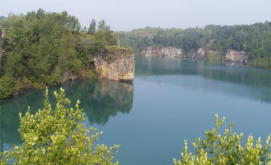
It was decided to backfill the Perlonjour quarry, situated about 1.5km to the west. This site, inactive since the late 1980s, has a configuration (very deep water, vertical and 'young' walls) that gives this site currently very little ecological value.
The investigation did, however, detect a small population of green frogs, a species strictly protected under Natura 2000, as well as a stock of carp; however, there was very scant avifauna, a reduced population of invertebrates and the near absence of riverine and aquatic vegetation.
Solution
The transport of the earth by a hydraulic system has started in 2008 and ensures optimal discharge. It avoids the addition of water for the hydraulic transport of surface soil does limit dispersion, reducing the leaching of compounds of agricultural origin, and also limiting any turbidity problems.
Despite the use of this particularly appropriate backfill technique, the development of valuable biodiversity will only be possible through the creation of a pioneer ecosystem and by controlled management.
Result
Although the complete back-filling of the Perlonjour quarry would have absorbed the entire volume of surface soil and perhaps made possible to return the site to agriculture, partial back-fill was preferred. This choice is justified by the wish to maintain the current habitat of the green frog population and by the willingness to contribute to the significant increase in biodiversity which this approach promises.
In 2018, the project was still on-going, some parts of the pump and some of the pipe have already been changed. The project will continue for 15 more years.