Carmeuse
Objective
Protection of a major sand martin colony.
Context
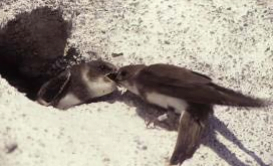
During spring 1989, sand martins took up residence in a crush limestone heap consisting of some sheer vertical walls. The site did not resemble the traditional alternative habitats - sandy and clayey - used by martins. However, that year, it appeared that some granulate masses, like the crushed limestone at Frasnes, attracted numbers of nesting martins.
Their natural nesting sites (along streams and rivers, with vertical banks that can be excavated) are unfortunately increasingly rare. Consequently, many sand martins are now breeding in manmade alternative habitats (mainly in quarries). These large and stable colonies make it possible to sustain the numbers from "satellite colonies", less permanent and generally situated on rather restricted natural sites. Preserving sand martins in quarries makes a real contribution to preserving biodiversity.
Solution
An NGO, "Les Bocages" asbl, together with Carmeuse, decided to protect this colony of birds, and then to research solutions which would maintain it. "Les Bocages" asbl built a structure in crushed limestone provided by Carmeuse for the sand martins. The selected site was at some distance from the quarry extraction activities and close to the slag pond.
The works began in January 1991. They consisted of erecting a foundation, a layer of shale (rakings from the deposits), form work and the stock of aggregate. The installation of form work, in wooden beams and sheets, proved to be indispensable. While retaining the limestone mass, it also made it easier to construct a vertical wall.
At this stage, it was impossible to predict whether the sand martins would adopt this new habitat. Various stratagems were used, firstly to dissuade them from returning to the old heap and secondly to attract them to their new home (in particular by installing loudspeakers emitting appropriate cries and by creating the beginnings of tunnels).
Result
In late April 1999, the first sand martins moved into their new apartments (80 pairs). Since then, each spring, after refashioning the nesting wall, the sand martins return to their new habitat. The colony has even successfully grown to 260 nesting pairs.
Partners
"Les Bocages" asbl, www.lesbocages.be.