Cimenteries CBR s.a. - HeidelbergCement
Objective
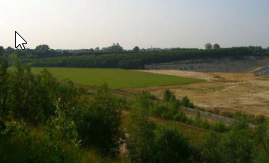
Restoration of a landscape of agricultural and environmental quality.
Context
Every day the quarry of the Romont supplies the factory of Lixhe with 1,800 tons of micaceous chalks, unrefined chalks and silts. The actual extraction area and its extension cover 220 hectares.
Entirely situated on high quality farmlands, in a municipality where more than 80% of the surface has in agricultural use, the planned project will result in agricultural soils of at least same quality.
The biodiversity that appeared on the quarry is not neglected and is the object of biological studies. The final goal is to restore a landscape of high agricultural quality, but also more rich in natural elements than before its exploitation as a quarry.
The agricultural rehabilitation of the quarry of the Romont was requested even before its opening, through an agreement between the CBR s.a. company and the Belgian State.
Solution
The works begin with the constitution of a bed of flint of approximately 1m thick on the floor. Quarrying wastes are then disposed by trucks. The reshaping and decompression are done by bulldozer. The topsoil layer, more than 30 cm thick, is finally brought and spread with mud.
The ground is then maintained as grassy fallow, regularly mowed for several years, to restore the organic matter stock of the ground and improve its structure. Amendments are realized to balance the pH, the Magnesium and organic matter contents.
Particular precautions are taken for the good management of the amendments to avoid the associated problems especially about the nitrogen. These topsoils are indeed situated in the protection zone of a drinking water collection area.
Result
A new program of survey concerning the ecological potentialities of the site, the present species and interest area is planned for the year 2009.
The land will be returned to the farmers, with at least an equal quality to adjacent farmland.
The landscape will however be more diversified and ecologically much more interesting than its original state. Cliffs and other natural habitats appeared with the progress of the quarry. Many of these elements will be maintained for these reasons at the end of the restorations.
Partners
Agronomic laboratory of the CIPF, Catholic University of Louvain: Professor Foucart oversees the collaboration and the prescribed operations.