HeidelbergCement
Objective
The objective is to continue the development of the landscape with a connected rift system to enhance the creation of habitats.
Context
With the approval of the extension of the production area at the western seaside and the deep dredging until a depth of around 40m were connected comprehensive compensation measures within the nature protection area “Allmendäcker”. In this report it was envisioned to create varying deep standing water bodies over the whole area. In the southern part of the area the compensation measures had already been implemented.
Because in the course of river regulations natural river banks got widely lost, especially those species, adapted to flat bank zones and surrounding wetlands, are in the focus of renaturation activities from the HeidelbergCement AG. Originally it was planned to develop a landscape with small water bodies in the whole area, like it was already done in the southern part. After an inspection of the site in august 2006 the idea to develop a connected rift system instead of isolated water bodies was born. The prolonged waterland border in comparison to small water bodies offers diverse habitats for all water bound species.
Solution
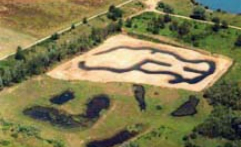
Before the creation of the rift system could be started, a comprehensive clearing of the developing forest and scrubland was necessary. Already 90% of the area was overgrown by different sized poplars, willows and birches.
Besides the clearing, it was planned to create wide areas of raw soil. Therefore a 15cm thick layer of soil was removed over the whole area. The removed surface soil including all comprised root material was reused for the modulation of the rift system as also to the build of a borderline in the north and the east around the area.
Result
It was established a 580m long system of connected rifts in order to create preferably diversified habitats. In between were established shallow water zones to ensure an easy accessibility for amphibians and to avoid the drowning of wild animals, like small mammals. To support the reproduction of amphibians and dragonflies, these flat banks have been created southerly orientated.
As a perfect and demonstrative example for natural succession on the raw soil and to show the fast colonisation of the water bodies and surrounding banks with rare amphibian and bird species, the renaturated quarry Forchheim is used to carry out excursions for school classes and other interested people. Additionally the advantage of secondary biotops with raw soil in comparison to the classical restoration with planting of forest is shown.