Aggregate Industries - Holcim
Objective
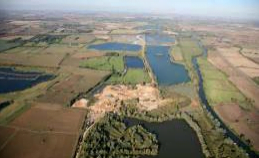
To create a mosaic of habitats, especially those effectively lost to the Ouse Valley floodplain through intensive agricultural activity, and flood control measures to accommodate both agricultural and urban development.
Specific target habitats are: wet grassland, wet woodland, secure breeding sites for groundnesting wetland birds, scrub and reedbed.
Context
Little Paxton Pits was designated as a Site of Special Scientific Interest in 1986 (128 hectares). Little Paxton Quarry is adjacent to Paxton Pits Nature Reserve, current size 77 hectares, which was itself formed from worked out gravel excavations. Paxton Pits Nature Reserve was declared and designated as a Local Nature Reserve in 1988. Following restoration, the reserve will extend to 285 ha.
Solution
Involvement of volunteers.
Creation of micro-habitats for invertebrates.
Management of the islands by staff and volunteers.
Result
Number of species of recorded birds has gradually increased across the extent of Paxton Pits from 157 to 216 over the last fifteen years.
The specially created islands with managed water levels have been spectacularly successful in attracting breeding birds. Special targets are lapwing and redshank which nest most years. Common terns and up to 4 species of gull breed on these islands.
Nightingale territories are spreading northwards from the reserve into the quarry as the quality of the scrub improves with age.
Sizeable sandmartin colonies are an annual feature within the quarry boundaries. The site was used in guidance published by the Quarry Products Association (QPA, now part of the Minerals Products Association).