UNICEM
Objective
To develop the knowledge of the ecological potential of massive rock quarries and to provide good practices regarding biodiversity to the quarry operators.
Context
A similar survey was done for the assessment of the ecological potentialities of quarries transformation into wetlands.
UNICEM wanted to provide knowledge and expertise to its massive rock quarry operator members.
The French government implemented a strategy for the preservation of biodiversity. Quarry operation may lead to the creation of interesting wetlands. This will provide feedback on the objectives of the strategy.
Solution
This survey was launched in 2000. At first, it consisted of doing bibliographical research on the ecological potentialities of eruptive massive rock quarries Then, fauna and flora inventories were carried out on 20 eruptive massive rock quarries and on 15 limestone quarries.
Result
This research has lead to identifying the key issues to take into account, explaining why biodiversity can develop more easily in some places than in others.
It has also lead to the development of the partnership with scientists.
This work provided good practices to the operator, in order to take into account biodiversity: before operation i.e. during the assessment survey stage, during operation and after with the quarry ecological transformation.
This research has highlighted the positive contribution to biodiversity from the massive rock quarries.
Some results were observed during the inventories:
▪ 123 nesting bird species, i.e. 42% of nesting bird species in France (294 species);
▪ 16 species of amphibians, i.e. 80% of the amphibians existing on the French territory;
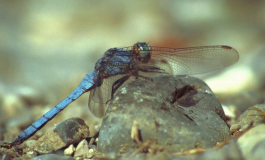
▪ 46 species of dragonflies : 54 % of the species existing in France;
▪ 124 species of night butterflies, 46 % of the species existing in France;
▪ 1119 vegetal species i.e. about 20% of the French flora.
The final purpose of this project was to write a recommendation guide with good practices.
The guide is now completed and can be consulted at the following link.