Holcim Spain
Objective
The main objective is to recover the natural habitats for aquatic bird, mixing the treatment and the emptying of the existing land and the existing vegetation to cover the basic needs of the different species: food, shelter an appropriate area for reproduction.
Context
The gravel pit has been exploited since almost 10 years. As a consequence of this exploitation, a few vats were created, and being under the water table, they are almost totally swamp.
Solution
For the creation and restoration of this natural habitats:
• The presence of reduced deep areas, the forming of banks, etc.
• The revegetation in areas where it was necessary, using existing autochthonous species in the surrounding gravel area.
• The construction of islands of different sizes and shapes, with a soft and irregular perimeter.
• The creation of appropriate perches on the banks, islands and on the same water (trunks, dead trees, etc).
A key point has been the severe prohibition of hunting and of human presence in the whole area, creating a protected land for aquatic birds. In 2018, the project was still on going.
Result
At the gravel pit there are several areas of great biological richness:
• Areas of deep water, where there are grebes, cormorants, ospreys, etc.
• Areas of slight water: one of the most productive places, used by almost all aquatic birds as resting place: grey heron, little egret, river kingfisher, mallards, etc.
• Helophyte vegetation: mediums with solid vegetation, of scarce visibility and a few free spaces. They are very important as nesting and refuge places for: purple heron, least bittern, bluethroat, etc.
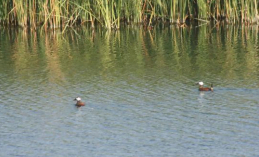
• The bank forest: of great interests for the bird fauna, where there are some of the most sparse species of the community, not seen outside of this habitat and in severe extinction danger. Here we can find too, several of the 40 specimens of white-headed duck still existing in Spain.
• The heaths and derelict land: kestrels, red-legged partridge, little owls, skylark, blackeared wheatear, etc.